


 Cart
Cart
 sales@molnova.com


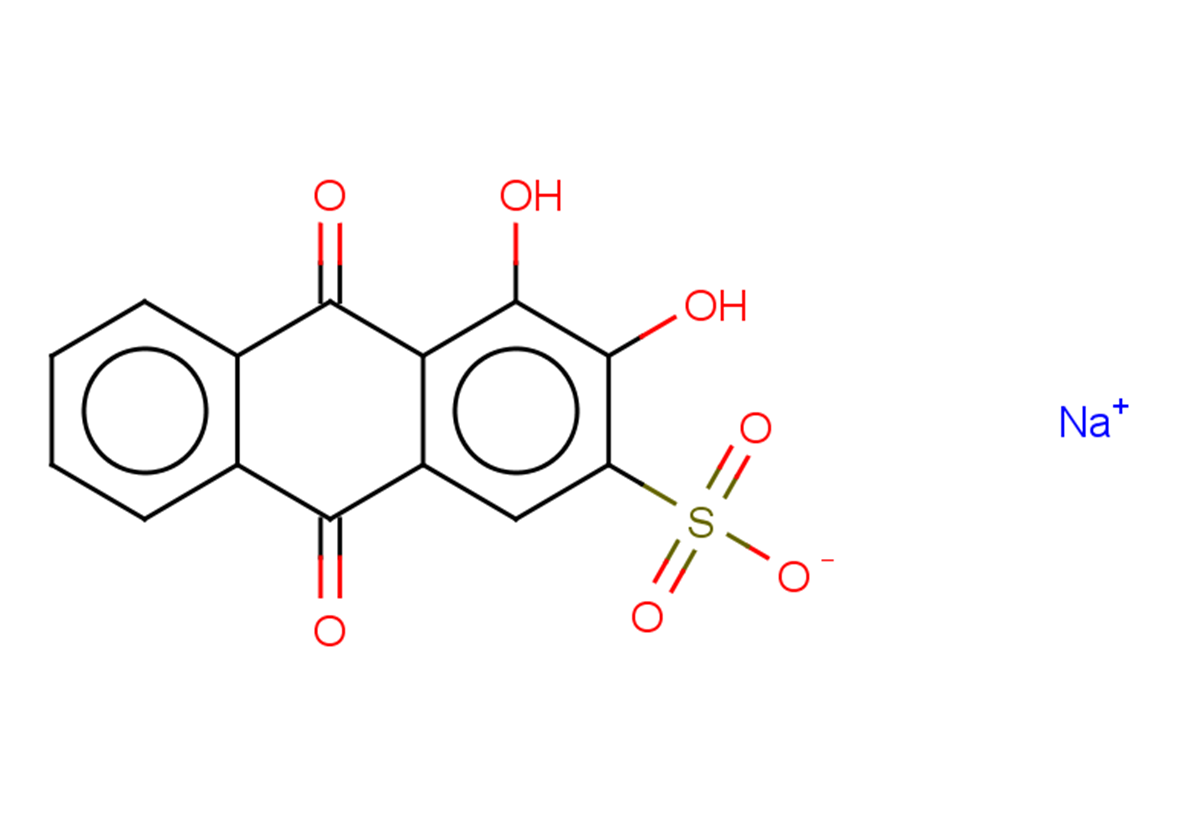
Alizarin Red S sodium
CAS No. 130-22-3
Alizarin Red S sodium( ARS sodium )
Catalog No. M23457 CAS No. 130-22-3
Alizarin Red S sodium (ARS sodium) is an anthraquinone dye. Which has been widely used to evaluate calcium deposits in cell culture.
Purity : >98% (HPLC)
 COA
Datasheet
HNMR
HPLC
MSDS
Handing Instructions
COA
Datasheet
HNMR
HPLC
MSDS
Handing Instructions
| Size | Price / USD | Stock | Quantity |
| 200MG | 45 | In Stock |


|
| 500MG | Get Quote | In Stock |
|
| 1G | Get Quote | In Stock |
|
Biological Information
-
Product NameAlizarin Red S sodium
-
NoteResearch use only, not for human use.
-
Brief DescriptionAlizarin Red S sodium (ARS sodium) is an anthraquinone dye. Which has been widely used to evaluate calcium deposits in cell culture.
-
DescriptionAlizarin Red S sodium (ARS sodium) is an anthraquinone dye. Which has been widely used to evaluate calcium deposits in cell culture.
-
In Vitro——
-
In Vivo——
-
SynonymsARS sodium
-
PathwayOthers
-
TargetOther Targets
-
RecptorOthers
-
Research Area——
-
Indication——
Chemical Information
-
CAS Number130-22-3
-
Formula Weight342.26
-
Molecular FormulaC14H7NaO7S
-
Purity>98% (HPLC)
-
SolubilityDMSO:5 mg/mL (14.61 mM; Need ultrasonic); H2O:10 mg/mL (29.22 mM; Need ultrasonic)
-
SMILES[O-]S(c(cc(c(C(c1c2cccc1)=O)c1O)C2=O)c1O)(=O)=O.[Na+]
-
Chemical Name——
Shipping & Storage Information
-
Storage(-20℃)
-
ShippingWith Ice Pack
-
Stability≥ 2 years
Reference
1.Lim S, et al. Stimulatory Effects of KPR-A148 on Osteoblast Differentiation and Bone Regeneration. Tissue Eng Regen Med. 2019 Jul 17;16(4):405-413.
molnova catalog



related products
-
MuRF1-IN-1
MuRF1-IN-1 is an inhibitor of muscle ring finger 1.
-
DCAI
DCAI is an inhibitor of nucleotide exchange and nucleotide release acting by binding to the pocket adjacent to the Ras-SOS interface.
-
Enbucrilate
Enbucrilate is a cyanoacrylate ester that has been used as surgical tissue adhesive. Enbucrilate is a tissue adhesive, forming polymer films at oil-water interfaces and revealing films of diverse morphology.
